The Arènes d’Arles, explained: the complete visitor guide
I was born in Arles and I live in the Roquette quarter, ten minutes’ walk from the amphitheatre. I watched my first Cocarde d’Or from the upper tiers as a child, and I spent five summers as a licensed guide in Provence, a good part of them standing under these arches explaining why the gate was shut.
What it is, and how it compares
The building is a Roman amphitheatre put up around 90 AD under Domitian, a decade or so after the Colosseum, in a town Julius Caesar had refounded in 46 BC for veterans of the Sixth Legion. It is an ellipse 136 m long and 107 m wide, 21 m high, with two tiers of 60 arches each, Doric below and Corinthian above; the attic storey is gone. About 34 rows held roughly 21,000 people, around 20th in size among the 400 or so Roman amphitheatres known. It is 3 m longer than Nîmes and a whisker older, but Nîmes kept its full outer wall. Arles has the UNESCO listing since 1981, the medieval towers, and the Théâtre antique 200 m down the hill. The two are 30 minutes apart by train; the comparison is on its own page.
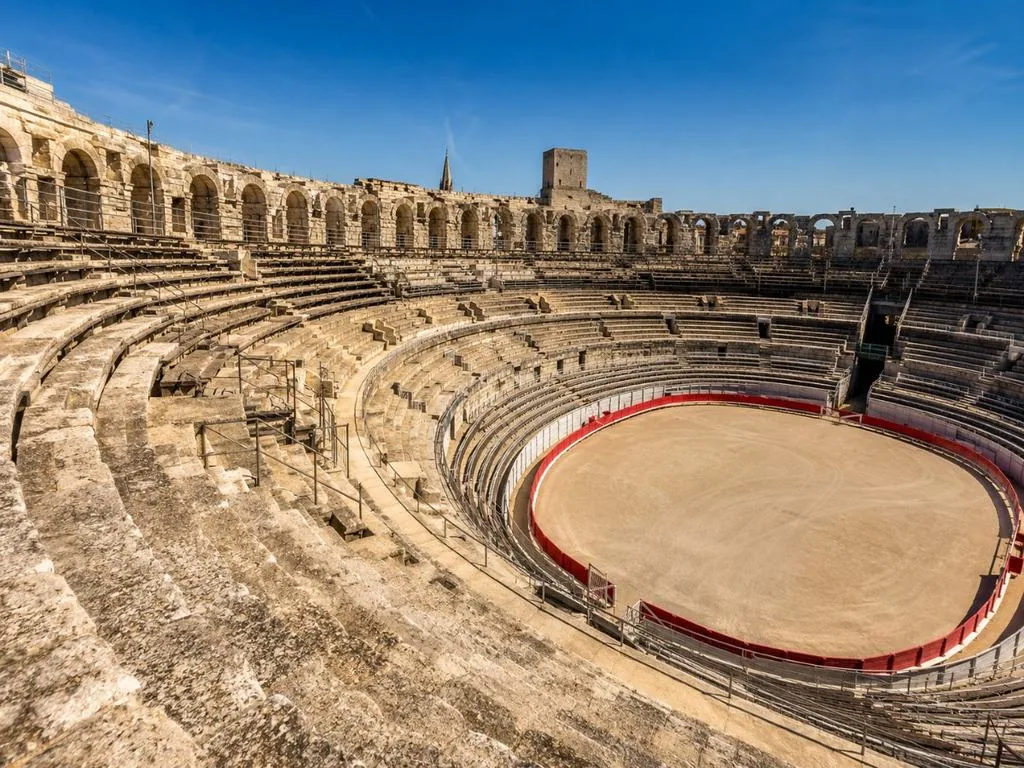
Two lives
In the 5th century the arcades were walled up and the building became a fortress. Four towers went on in the 12th century, and a town grew inside: more than 200 houses, streets, two chapels. Clearing it took from 1826 to 1830, and the first thing the town did with the empty ellipse was hold a bull race, in 1830. It has not stopped. Arles is France’s oldest working bullring, one of seven first-category rings, and on spectacle days the monument closes to sightseers. The Feria de Pâques shuts it from Friday 3 to Monday 6 April 2026, the Cocarde d’Or on Monday 6 July, the Feria du Riz from 11 to 13 September, and the summer concerts on their own dates. On those days the town is full, nine bodegas at Easter, and there is no point arriving with a monument ticket in your hand.
Two different things happen in the ring. In a corrida, Spanish-style, the bull is killed. In a course camarguaise, nothing bleeds: raseteurs in white use a small hook to snatch a ribbon, two tassels and some strings from the horns of a Camargue cocardier, who is in the ring for at most 15 minutes and goes home to the manade afterwards. Both are on the 2026 calendar, and the difference matters if you are deciding whether to buy a seat.
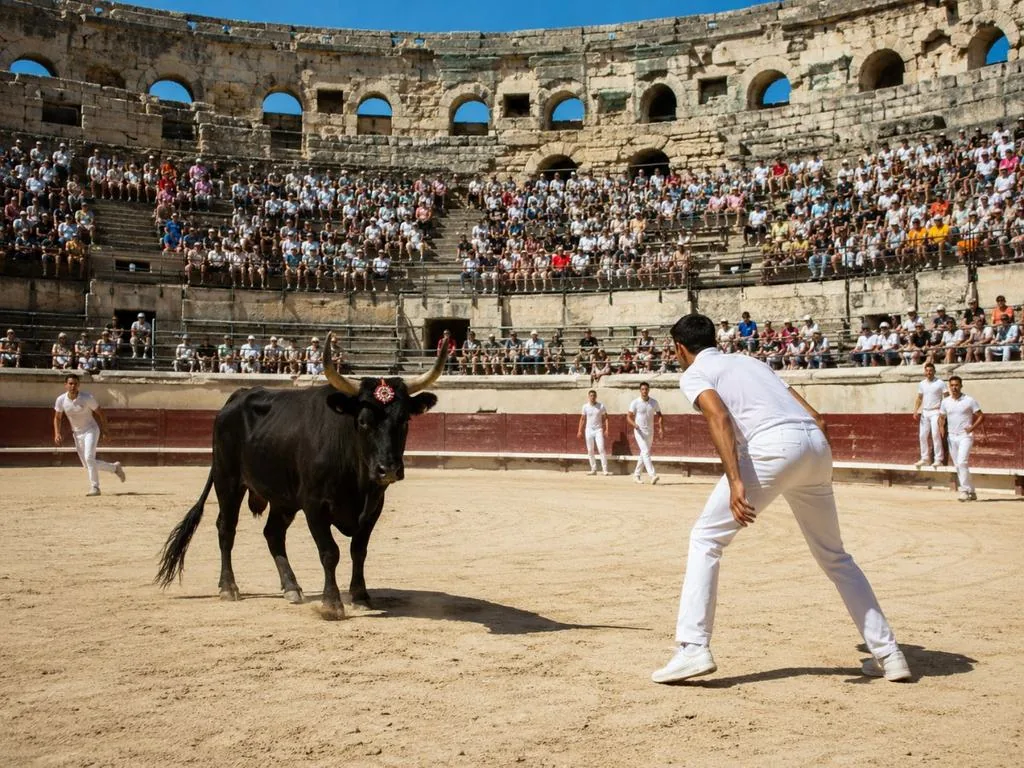
How to get in
You do not need a tour. Buy a monument ticket at the desk under the arches, at the Office de Tourisme on boulevard des Lices, or online at arlestourisme.com, and walk in. There is a combined ticket with the Théâtre antique, which is the one I buy for visitors. The Pass Liberté is valid a month and covers four monuments of your choice, the Musée Réattu and one more museum; the Pass Avantage is valid six months and covers all six monuments and four museums. Either pass is better value once you plan on three monuments or more. Under-18s go in free. None of the six GetYourGuide tours on this site includes the entry; the box office at arenes-arles.com sells seats for the spectacles, nothing else. The ticket page goes through all of it.
The closed days, and the hours on the open ones
From 1 May to 30 September the monument is open 9:00 to 19:00; in March, April and October 9:00 to 18:00; from 2 November to the end of February 10:30 to 16:30 with last entry at 16:00. Otherwise last entry is 30 minutes before closing; shut on 1 January, 1 November and 25 December. An event overrides these hours without ceremony, so confirm the date on arlestourisme.com first. Hours by season has the table.
The visit, stop by stop
The desk is under the ground-floor arches. From it you enter the covered gallery that runs round the whole ellipse. Then the arena floor, sand and barriers on a visiting day, and the 34 rows rising above you. The tiers are stairs only, and the paving everywhere is Roman and uneven, so wheelchairs and strollers stay on the ground level. One of the three surviving towers can be climbed, and the view over the roofs to the Rhône is the reason to do it before the heat. Most people are out in 45 to 60 minutes; an hour and a half if you climb and read the panels.
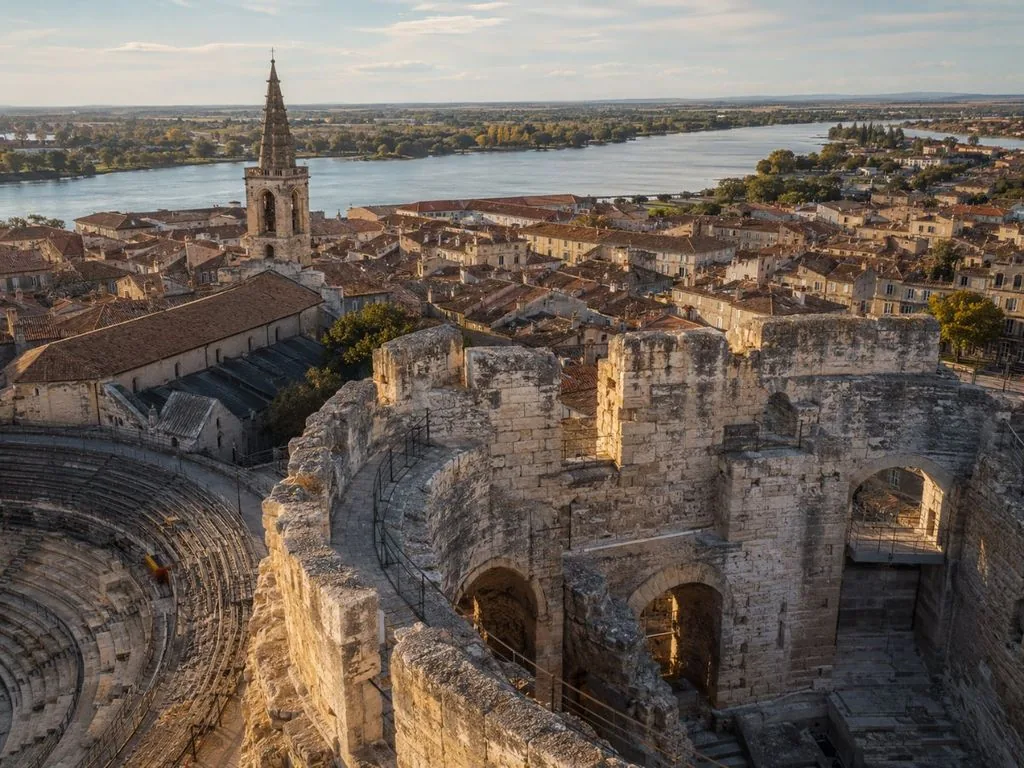
Pairing it with the theatre and the town
I send friends to the theatre first and the arena second, because the theatre is empty at nine. It was built under Augustus around 12 BC, holds 10,000, and keeps two columns the town calls les deux veuves. From there it is a short walk to place de la République, the Saint-Trophime portal and cloister, and the town hall, under which the cryptoportiques run. Van Gogh’s café is on place du Forum; on a Saturday the market on boulevard des Lices runs 8:00 to 12:45. The walking order is on one page, and how long to give each stop on another.
When a tour helps
Nobody needs a tour just to see the arena. A tour is worth adding in two cases. If you are in Arles with an hour to spare, the express walk meets two minutes from the amphitheatre and finishes in the Roquette, my own quarter. If you are staying in Aix, Marseille or Avignon and want Les Baux and Saint-Rémy in the same day, a small-group minibus does that with 1.5 hours of free time in Arles, enough to buy a ticket and go in. The private walk is charged per group, so it makes sense for four or more, or for anyone who wants a guide in German, Italian or Spanish. The Avignon Van Gogh half-day includes one entry, and it is Saint-Paul-de-Mausole, not the arena. All six are compared without a number in sight, and the live dates are in the booking widget.
Ready to book?
If you have a spare hour in Arles, the express walk starts two minutes from the arches and finishes in my own quarter. For a full day out of Aix, the small-group day trip below is the one I send visiting friends on. Both cancel free up to 24 hours before.
Frequently asked questions
Do I need a tour to visit the Arènes d’Arles?
No. You walk in with a monument ticket or an Arles pass and follow the panels at your own pace; a visit takes 45 to 60 minutes. A tour makes sense if you want the whole town explained in an hour, or a day that also covers Les Baux and Saint-Rémy — see all tours.
Is the amphitheatre open during the Feria d’Arles?
Not to sightseers. It closes from the Friday to the Easter Monday of the Feria de Pâques (3 to 6 April 2026) and on the spectacle days of the Feria du Riz (11 to 13 September 2026) and the Cocarde d’Or (6 July 2026). The opening hours page lists every closure.
Which pass is better, Liberté or Avantage?
The Pass Liberté covers four monuments plus the Musée Réattu and one more museum for a month; the Pass Avantage covers all six monuments and four museums for six months. If you will see the theatre, the cloister and a museum as well as the arena, the Avantage is the simpler choice — the tickets page compares them.